
- Your cart is empty
- Continue shopping


-
Admin
- Posted on
- Categories:Dried Mango
The word “manufacturer” on a Vietnam dried mango manufacturer’s website can mean three different things. It can mean a company that owns a drying plant and sells whatever it makes. It can mean a trader who buys finished product and re-labels it. Or it can mean an exporter that produces to its own specification in partner plants, with its own staff on the line.
Helena Foods is the third kind. This article explains how the partner-plant model works and what you should ask of any manufacturer, whichever kind it turns out to be.
What does a Vietnam dried mango manufacturer actually control?
A Vietnam dried mango manufacturer working through partner plants controls four things: the raw material, from its farming network; the specification, agreed before production; the production run, through its QC staff at the plant; and the evidence, through lot codes and a certificate of analysis per lot. Who owns the building matters less than who controls these four.
Inside the partner-plant model
Raw material from the farming network
Helena sources through a network of more than 1,000 farming households and cooperatives across Vietnam, many of them the same families who grow coffee in the Central Highlands. For mango that means fruit from Đồng Tháp, Tiền Giang and An Giang in the Mekong Delta, and from Khánh Hòa, Sơn La and Đắk Lắk, in the varieties that dry well: Cát Chu, Cát Hòa Lộc, Keo, Tứ Quý and Đài Loan. Which variety suits which product is covered in Vietnamese mango varieties for drying.
Specification agreed before production
Nothing is produced until a spec sheet exists. It fixes ingredients (mango, sugar), moisture, cut and piece size, colour, the additive specification, packing and shelf life, and it is the document the sample, the quotation and later the COA all refer to. A manufacturer who quotes before a spec sheet is quoting for an undefined product.
QC on the line
Our own QC staff are at the partner plant during production and packing. They check ripeness at sorting, the infusion step, the drying endpoint against the agreed moisture, the sorting of pieces by colour and size, and the packing. They also verify that the plant’s own control steps, including metal detection, are carried out and recorded for the lot. The drying process itself is described in how soft dried mango is made.
Lot codes and the COA
Every carton carries a lot code linking it to region, plant and production date. Every lot ships with a certificate of analysis reporting against the spec sheet, and independent testing by SGS or Eurofins before loading is available on request. The full system is on the quality page.
Checkpoint vs evidence: what to ask any manufacturer
Any Vietnam dried mango manufacturer should be able to answer the questions below with documents rather than assurances, whether the plant is owned or partnered.
| Checkpoint | Why it matters | Evidence to ask for |
|---|---|---|
| Capacity and season planning | Mango is seasonal; the plant must dry your volume inside the window | A production plan against your delivery window |
| Hygiene and pest control | Dried fruit attracts insects and mould if the plant is poorly run | The plant’s hygiene programme, pest-control records, certifications held by the plant |
| Metal detection | Cutting and drying equipment can shed fragments | Confirmation of the plant’s metal detection step and its check records |
| Drying control | Moisture decides texture, water activity and shelf life | Moisture and water activity on the COA of each lot |
| Traceability | Complaints and recalls must lead back to a plant and a date | The lot code logic and an example code decoded |
| Packing and storage | Finished fruit picks up moisture and odours | Packing spec, liner, storage conditions before loading |
| Documents | Customs and your own QA need them on time | Spec sheet, COA per lot, SGS or Eurofins report on request |
Why produce through partner plants rather than one owned factory?
Mango ripens at different times in the Mekong Delta, the south-central coast and the highlands, and fruit should be dried close to where it is picked. Partner plants in the Central Highlands and other regions let production follow the fruit and let volume scale without one plant becoming the bottleneck. The specification stays the same whichever plant runs the lot.
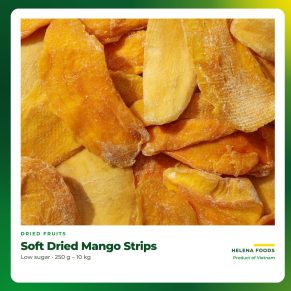
The trade-off is that control has to be built deliberately rather than assumed from ownership. That is exactly what the spec sheet, the QC presence, the lot code and the COA are for. As the Helena Foods site puts it: trust is not a certificate, it is the tenth container arriving exactly like the first. The product this model produces is described on the soft dried mango product page, with jackfruit and banana on the dried fruits category page.
Frequently asked questions
Does Helena Foods own a dried mango factory?
No. Helena Foods manufactures dried mango through partner processing plants in Vietnam. It controls the raw material through its farming network, the specification agreed before production, the production run through its own QC staff on site, and the evidence through lot codes and a certificate of analysis for every lot.
Can I check the plant that will produce my lot?
The lot code identifies the plant, so ask for the plant’s hygiene documentation, the certifications it holds and its metal detection and traceability records alongside the spec sheet. Judge the plant on those records and on the COA of the first lot; the same checks apply whether the exporter owns the plant or not.
How is consistency kept between lots and between plants?
Through one spec sheet. Every lot, whichever plant produces it, is run against the same agreed parameters, checked by the same QC staff and reported on its own COA. Comparing the COA of each new lot with the previous one, and keeping the retained sample from the first order, shows at once whether anything has drifted.
What is the difference between a manufacturer and an exporter?
In practice the labels overlap. The useful question is who controls the specification and the production run. A trader exports what a plant happens to make; a manufacturer, owned or partnered, produces to a specification it has agreed with you and can prove it with a COA for every lot and a lot code on every carton.
Request a quote or sample
If you are comparing a Vietnam dried mango manufacturer against the checklist above, start with ours. Send the format and destination to receive a PDF spec sheet, sample options and a quotation. Contact us to start.
