
- Your cart is empty
- Continue shopping


-
Admin
- Posted on
- Categories:Dried Fruits
A dried tropical fruits export company is judged on one afternoon: the day the container doors open at the buyer’s warehouse. Everything that decides what the buyer sees happened months earlier: in an orchard in the Mekong Delta or the Central Highlands, on a drying line at a partner plant, and in a laboratory report read before loading. This article follows one order through those stages, as Helena Foods runs it, and shows what the buyer receives at each step.
We are the food-export company of the Helena group, headquartered in Buôn Ma Thuột in Đắk Lắk, and our dried fruits are soft dried mango, jackfruit and banana. The chain below is the same for all three.
What does a dried tropical fruits export company actually do?
A dried tropical fruits export company sources fruit from growers, has it processed to an agreed specification, checks and documents every lot, and ships it with the paperwork the destination requires. In Helena’s case that means a farming network, partner plants with our QC staff present, a COA for every lot, independent testing on request and one contact person who runs the order from enquiry to arrival.
Stage 1: the farming network
The group began in 2016 as Helena Coffee, founded by Edison Nguyen together with a farming family in Đắk Lắk, and has exported Vietnamese agricultural products since then to buyers in more than 55 countries. The food business was established in 2020 on the same base: a network of more than 1,000 farming households and cooperatives across Vietnam. The families who grow coffee in the Central Highlands also grow mango, jackfruit and banana, and mango also comes from the Mekong Delta provinces of Đồng Tháp, Tiền Giang and An Giang, from Khánh Hòa and Sơn La.
For a dried fruit order, this stage decides variety, ripeness window and harvest timing. Which Vietnamese mangoes dry best is covered in Vietnamese mango varieties for drying; the fruit is chosen for the drying line, not the fresh market, and its region is recorded in the lot code from the start.
Stage 2: partner plants and Helena QC
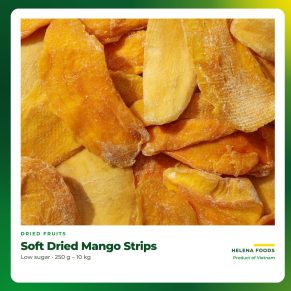
We do not own the processing plant. Production runs at partner plants in the Central Highlands and other regions, and three things are fixed before it starts: a spec sheet agreed with the buyer, the plant and line that will run the order, and our own QC staff on site during production and packing. For soft dried mango, our largest line by volume, the fruit is cut, infused in sugar syrup, gently dried to a moist, chewy texture, sorted and packed in 500 g pouches or boxes in export cartons, or in bulk packing on request. Jackfruit and banana follow the same routine with their own spec sheets.
The QC staff confirm that what the line produces matches the sheet, at the stages where it can still be corrected, and sign off the lot before packing. Every carton leaves with a lot code that links it to region, plant and production date.
Stage 3: testing
A certificate of analysis is issued for every lot, reporting the parameters on the spec sheet: moisture, water activity, sugar, defects, microbiology and contaminants. Where the buyer wants a second opinion, SGS or Eurofins tests the lot before loading, on request and listed on the quotation. The results are read before the container is booked, not after it has sailed. This is the core of the quality system we apply to every product; trust, as we put it, is the tenth container arriving exactly like the first.
Stage 4: documents, consolidation and loading
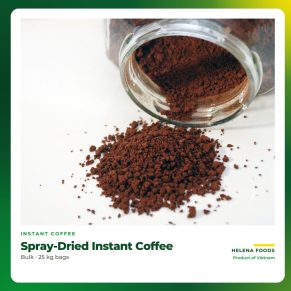
One person runs the order from spec sheet to arrival and issues one set of export documents: commercial invoice, packing list, bill of lading, certificate of origin, the COA, and any destination-specific certificate such as a phytosanitary certificate where required. Buyers who also take instant coffee from the group can load it in the same dry 20ft or 40ft container as their dried fruit, under the same documents and contact. Lot codes on cartons, packing list and COA match, which is the first thing a customs officer or warehouse supervisor checks.
Stage by stage: what we do and what the buyer receives
| Stage | What we do | What the buyer receives |
|---|---|---|
| Enquiry and specification | Draft spec sheet, sample, quotation with MOQ and lead time on request | Spec sheet PDF, sample, written quotation |
| Sourcing | Fruit from the farming network, selected for the drying line | Region recorded in the lot code |
| Production | Partner plant run with our QC staff on the line | Product to spec; QC sign-off per lot |
| Testing | COA for every lot; SGS or Eurofins before loading on request | COA; independent report where requested |
| Packing and loading | Export cartons, pallets, dry container; consolidation with coffee if wanted | Packing list with lot codes; loading photographs |
| Documents and arrival | One document set issued by one contact | Invoice, packing list, B/L, C/O, COA, destination certificates |
Frequently asked questions
Does a dried tropical fruits export company need to own its plant?
No, and many do not. What a buyer needs is control of the specification, a competent person on the line while the lot is made, and evidence afterwards. We produce at partner plants with our own QC staff present, agree the spec sheet first and issue a COA for every lot, so the buyer gets that control regardless of who owns the building.
Can I buy mango, jackfruit, banana and coffee from one company?
Yes. Soft dried mango, jackfruit and banana are produced with our processing partners, and instant coffee is the group’s original product, so the four can be consolidated in one dry container with one set of export documents and one contact person. Roasted and green coffee are handled separately through the group’s coffee business.
How do I start an order?
Send the product and cut, the pack format, the destination market and your expected volume. You will receive a draft spec sheet, a sample from a current lot and a quotation stating MOQ and lead time for that format. Once the spec sheet is agreed, production is scheduled with the partner plant and our QC staff.
Request a quote or sample
If you are looking for a dried tropical fruits export company in Vietnam, send Helena Foods your product, cut, pack format and destination market. You will receive a draft spec sheet, a current-lot sample and a quotation, with coffee consolidation if you want it. Contact us to request a quote or sample.
