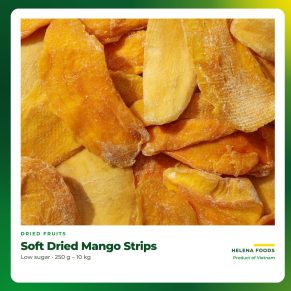
What a dried mango specification covers and why each line matters: moisture around 15–20%, water activity below about 0.65, sugar level, colour reference, strip size, defect limits, declared additives including sulphites, and microbiological limits. Includes a specification table and what Helena’s COA and SGS or Eurofins testing report for each lot.
Dried Fruits
Guides for buyers of Vietnamese soft dried mango, jackfruit and banana: sourcing, specifications, private label and export.
How to launch private label dried mango from Vietnam: agreeing the specification, approving a sample, choosing pouches, boxes or bulk cartons, labelling basics, QC and COA, and shipping. Includes Helena’s six-step OEM process, a decision table by sales channel, and how to pair dried mango with cashews in one snack range.
Cát Chu, Cát Hòa Lộc, Keo, Tứ Quý and Đài Loan mango each bring different sugar, fibre, colour and firmness to the dryer. This guide compares the five main Vietnamese mango varieties, maps the growing regions from the Mekong Delta to Sơn La and Đắk Lắk, and explains how seasonality shapes soft dried mango supply.
A step-by-step account of how soft dried mango is made at Helena’s partner plants in Vietnam: fruit selection and ripeness, washing and peeling, slicing, sugar syrup infusion, controlled drying, cooling, sorting, metal detection and packing, with a table of what is controlled and recorded at each stage.
Soft dried, hot-air dehydrated and freeze dried mango start from the same fruit but differ in texture, moisture, shelf life and cost. This guide compares the three processes, explains what moisture and water activity mean on a spec sheet, and shows which format suits snacks, cereal and ingredient use.