
- Your cart is empty
- Continue shopping


-
Admin
- Posted on
- Categories:Instant Coffee
A soluble coffee bulk supplier is usually asked one question before any other: spray-dried, agglomerated or freeze-dried? The three forms start from the same coffee extract, dissolve in the same cup and ship in the same 25 kg bags, yet they look different, weigh different amounts per litre, behave differently on a filling line and sit at different points on the price scale. This article compares them from the bulk buyer’s side and explains which one Helena Foods recommends for which use.
Which forms should a soluble coffee bulk supplier offer?
Soluble coffee is sold in bulk in three physical forms. Spray-dried powder is made by atomising coffee extract in hot air; agglomerated granules are spray-dried powder re-wetted and fused into larger particles; freeze-dried granules are made by freezing the extract and removing the water under vacuum, a slower process that keeps more aroma.
Helena supplies spray-dried instant coffee as its standard bulk product and freeze-dried instant coffee for buyers who need it, both produced to specification at partner plants in Vietnam from a robusta base or an arabica/robusta blend. If your line needs agglomerated granules, raise it at the enquiry stage so the option can be confirmed for your specification.
Spray-dried powder: the bulk standard
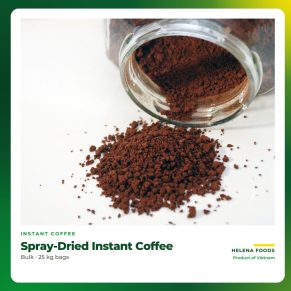
Spray-dried powder is fine, light and uniform. Its bulk density sits at the lower end of the usual 0.2 to 0.35 g/ml range, moisture is held at or below 5%, and it dissolves fully in hot water. Because it is the most direct product of the dryer, it carries the lowest cost position of the three and is the form most mixing plants, RTD producers and vending operators are built around.
Its limitations are cosmetic rather than functional: a fine powder can dust during filling and does not look like ground coffee in a glass jar. For a 3-in-1 sachet or an RTD extract neither matters; for a premium retail jar it might.
Agglomerated granules: powder with a second step
Agglomeration takes spray-dried powder and binds it into porous, irregular granules. The result wets faster with less dusting, has a higher bulk density within the same range, and looks closer to roasted coffee on the shelf. The extra process step generally places it between spray-dried and freeze-dried in cost. It is the usual choice when a jar product needs a granular look at a spray-dried price, or when a sachet line wants better flow.
Freeze-dried granules: aroma first
Freeze-drying never exposes the extract to hot air, so volatile aroma compounds that spray-drying loses are retained. The granules are larger and angular, dissolve readily and present well in clear jars. The process is slower and costlier, which is why freeze-dried coffee is positioned as the premium bulk option and is chosen for retail jars, sticks and blends where cup aroma is the selling point rather than price per cup. Freeze-dried coffee from Helena is specified and tested the same way as spray-dried: specification sheet before production, COA for every lot and SGS or Eurofins testing before loading on request.
Soluble coffee bulk supplier comparison: three forms side by side
| Criterion | Spray-dried powder | Agglomerated granules | Freeze-dried granules |
|---|---|---|---|
| Appearance | Fine, light, uniform | Irregular porous granules | Larger angular granules |
| Bulk density | Lower end of 0.2 to 0.35 g/ml | Higher end of the range | Per spec sheet |
| Solubility | Full in hot water; may dust | Wets fast, little dust | Dissolves readily |
| Aroma retention | Standard | Standard, as spray-dried | Highest |
| Cost position | Lowest | Intermediate | Highest |
| Typical bulk use | 3-in-1, RTD, vending, bakery | Jars, sachets needing flow | Premium jars, sticks |
| Helena supply | Standard, 25 kg bags | Confirm at enquiry | To specification |
All three forms share the same storage rules (sealed bags, cool and dry, typically 18 to 24 months) and the same HS code, 2101.11, to be confirmed with your customs broker. Process detail is in spray-dried versus freeze-dried instant coffee.
Choosing by application
Choose spray-dried powder when the coffee is an ingredient that disappears into a mix, a drink or a dough and price per kilogram of soluble solids is the decisive number. Choose agglomerated granules when the product is seen by the consumer but must stay at a spray-dried price point. Choose freeze-dried granules when aroma in the cup is what the brand sells. Many buyers run two forms side by side, which is simpler when one soluble coffee bulk supplier produces both under the same quality system.
Frequently asked questions
Is freeze-dried coffee always better than spray-dried?
Not for every use. Freeze-dried coffee retains more aroma, but in a 3-in-1 sachet with creamer and sugar, or in an RTD can processed at high temperature, that advantage is largely masked and the higher cost is not recovered. Spray-dried powder is the better choice wherever the coffee is an ingredient rather than the product.
Do the three forms have the same caffeine content?
Caffeine depends on the beans and the extraction, not on the drying method. A robusta-based soluble coffee typically contains around 3 to 4% caffeine whichever form it takes, and the exact value for your lot is reported on the certificate of analysis. Blends with arabica lower the figure.
Can I switch forms without changing my recipe?
The soluble solids are comparable, but density changes the volume a given weight occupies, so volumetric fillers need re-calibration and sachet weights should be re-checked. Dissolution speed and appearance also change. Trial the new form on your line with a sample before converting a production order.
How does a soluble coffee bulk supplier pack each form for export?
All three ship in sealed bags, with 25 kg the standard unit for spray-dried powder, loaded into dry 20ft or 40ft containers; a 20ft container takes roughly 6.6 tonnes of spray-dried powder. Each bag carries a lot code linking it to region, plant and production date, and each lot has a COA.
Request a quote or sample
Tell Helena Foods the application, the form you prefer and the volume per shipment, and you will receive a draft specification, samples on request and a quotation. The standard powder is described on the spray-dried instant coffee bulk page, with the wider range in the instant coffee category; to compare forms on your own line, contact us for a quote or sample.
