
- Your cart is empty
- Continue shopping

-
Admin
- Posted on
- Categories:Instant Coffee
Premium spray dried instant coffee is defined by numbers a laboratory can check, not by the gold on the label. Three process decisions set it apart from a commodity powder: how much the plant extracts from each kilogram of green coffee, whether volatile aroma is captured and returned before drying, and how tightly density and moisture are held. A fourth sits upstream, in the freshness of the green coffee itself. This article explains each marker, how to write it into a specification and which test confirms it.
What makes premium spray dried instant coffee premium?
Premium spray dried instant coffee is soluble coffee produced from fresh, defect-sorted green coffee at a lower extraction yield for a cleaner cup, with aroma recovered and added back before drying, and with density and moisture held in a narrow band. It is confirmed by cupping against a reference and by the figures on the certificate of analysis (COA), not described with adjectives.
The word premium is used loosely in the trade, so a buyer who wants the substance should ask for the markers below one by one. A plant that can discuss them in process terms is making the product.
Marker 1: extraction yield and the clean cup
A soluble coffee plant can push yield by extracting at higher temperatures, which breaks down more of the bean into soluble solids. Those extra solids carry woody, harsh and burnt notes. Premium production stops earlier, accepting a lower yield so that the cup stays clean and closer to brewed coffee. The cost is more green coffee per kilogram of powder.
How to specify: a sensory reference sample, a strength target at a stated dose, and descriptors to exclude (burnt, woody, smoky). How to test: a trained panel cups each lot against the reference at the agreed dose.
Marker 2: aroma recovery
Volatile aromatics are lost at every hot stage of the process: extraction, concentration and drying. Plants equipped for it strip aroma from the ground coffee or the extract early, hold it, and return it to the concentrate before atomisation, so that more of the original aroma survives into the powder. The effect is noticed when the bag or jar is opened and again in the cup.
How to specify: aroma intensity on opening and in the cup, scored against the reference. How to test: sensory comparison of fresh and aged samples; freeze-drying remains the stronger route for aroma, as the spray-dried vs freeze-dried comparison explains.
Marker 3: controlled density, moisture and particle
Density and moisture are set at the dryer and decide how the powder behaves in the pack and the cup. Premium production holds bulk density in a narrow band inside the typical 0.2–0.35 g/ml range, keeps moisture at or below 5% and often at 3–4%, and avoids fines that dissolve into haze or lumps that dissolve slowly. The guide to how spray-dried instant coffee is made shows where each setting sits in the process.
How to specify: density band, moisture maximum, particle description and a dissolution test. How to test: bulk density and moisture on the COA, sieve analysis and a timed dissolution with a sediment check.
Marker 4: fresh, sorted green coffee
No downstream process repairs tired green coffee. Premium powder starts with current-crop beans, sorted for defects and stored dry before roasting. Helena’s sourcing network of 1,000+ farming households and cooperatives in Vietnam’s Central Highlands supplies the robusta base, and the lot code on every bag links the powder back to region, plant and production date, so crop year and origin are traceable rather than assumed.
Premium marker vs test
| Premium marker | How to specify | How to test |
|---|---|---|
| Lower extraction yield | Sensory reference, strength at stated dose, excluded descriptors | Panel cupping against reference, each lot |
| Aroma recovery | Aroma intensity on opening and in cup | Sensory comparison, fresh vs aged sample |
| Controlled density | Narrow band within 0.2–0.35 g/ml | Bulk density on COA |
| Moisture | At or below 5%, target 3–4% | Moisture analysis on COA |
| Particle and dissolution | No lumps or fines; timed dissolution | Sieve analysis, dissolution and sediment test |
| Caffeine | Typical range around 3–4% for robusta base | Laboratory analysis; SGS or Eurofins on request |
| Green coffee freshness | Crop year and origin on spec sheet | Lot code traceability to region and date |
How Helena supplies and verifies it
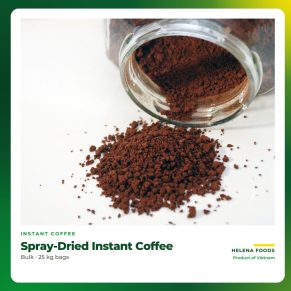
The markers above are written into the specification sheet agreed before production for spray-dried instant coffee (bulk). QC staff from Helena Foods are at the partner plant during production and packing, every lot carries a COA, and independent testing by SGS or Eurofins is arranged before loading on request; the system is described on the quality page. Powder ships in 25 kg bags, about 6.6 tonnes per 20ft container, with freeze-dried and agglomerated options in the instant coffee bulk range.
Frequently asked questions
Is premium spray dried instant coffee as good as freeze-dried?
Not on aroma, where freeze-drying retains more because it avoids hot air. On cup cleanliness, density control and moisture, a well-made spray-dried powder with aroma recovery comes close at a lower cost position. Which matters more depends on whether the product is drunk black from a jar or mixed with creamer and sugar.
Why does lower extraction yield cost more?
Because the plant uses more green coffee to make each kilogram of powder. Stopping extraction before the harsh fractions are released leaves soluble material in the spent grounds, and that material has to be replaced by additional beans. The buyer pays for cleaner flavour with raw material.
Does premium mean arabica?
No. Premium describes how the coffee is processed, not which species it is. A fresh, well-sorted robusta extracted at lower yield with aroma recovery is a premium product; a tired arabica extracted hard is not. Blends with arabica are available to specification where the cup target calls for more acidity and aroma.
How do I check a premium claim before ordering?
Request a sample and the spec sheet, cup the sample against your reference at the stated dose, and compare the COA figures for moisture, density and caffeine with the specification. Ask the supplier to explain extraction yield and aroma recovery in process terms; the answers show whether the markers are real or borrowed.
Request a quote or sample
Send Helena Foods your cup target, format and market, and we will reply with a specification draft covering the premium markers and sample options for cupping. MOQ, lead time and prices are quoted per order. Contact us to request a quote or sample.
