
- Your cart is empty
- Continue shopping


-
Admin
- Posted on
- Categories:Cashew Kernels
A sample of high quality Vietnam cashew nuts usually arrives as one or two vacuum bags, a COA and a spec sheet, and most of what you need to know can be checked at a desk in under an hour. No laboratory is needed for the first pass, provided you check the right things in the right order.
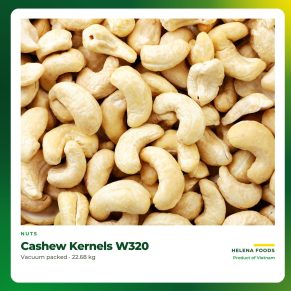
Helena Foods ships samples of its W320 and W240 white kernels on request, each from a coded lot with its COA. The ten checks below need a kitchen scale, white paper and daylight, and they tell you whether a kernel deserves approval and what to write on the specification sheet.
What makes high quality Vietnam cashew nuts?
High quality Vietnam cashew nuts are white whole kernels of the stated AFI grade, with a kernel count inside the range, moisture of 3–5%, a low share of broken pieces, few scorched or discoloured kernels, no foreign matter or adhering testa beyond tolerance, a clean sweet taste with no rancidity, and an intact vacuum pack whose lot code matches the COA.
Before you start
Inspect the sealed bag first, then open it over white paper in daylight. Weigh the sample before sorting anything, because several checks are percentages by weight, and keep the spec sheet beside you so each result lands next to its tolerance.
The 10 checks for high quality Vietnam cashew nuts
- Count per kg. Weigh 100 g of whole kernels, count them and multiply by ten. W320 should give 660–706 per kg (300–320 per lb); W240 should give 485–530 per kg (220–240 per lb).
- Colour. A “W” grade is white to pale ivory and uniform across the sample; light brown patches point to scorched kernels, which belong to the SW grade.
- Broken pieces. Separate splits, butts and pieces from the wholes, weigh them and express them as a percentage of the sample. Compare with the broken ratio on the COA and the tolerance on the spec sheet.
- Scorched kernels. Count kernels with brown or blistered areas from over-heating during shelling or drying. A white grade should show very few.
- Moisture feel. Snap a few kernels. At 3–5% moisture a kernel breaks cleanly; a kernel that bends is too wet, and one that crumbles to powder is over-dried. Confirm against the moisture figure on the COA.
- Taste and rancidity. Smell the bag as it opens, then chew three or four kernels. A good kernel is mild, creamy and slightly sweet; a bitter or paint-like aftertaste means rancidity, and sour notes suggest poor drying.
- Foreign matter. Look for shell fragments, stones, string, hair or insect parts. Any foreign matter in a small sample is serious, because the sample is the lot at its best.
- Testa remnants. Count kernels with flakes of the thin brown skin left after peeling. A small tolerance is normal and belongs on the spec sheet.
- Packaging vacuum. Before opening, the bag should feel as hard as a brick. A soft bag means the seal or film has failed, and oxygen has been reaching the kernels since the leak began.
- Lot code. Check that the code on the bag matches the COA. Helena’s lot code links the kernels to region, plant and production date.
Checks at a glance
| Check | Pass signal | If it fails |
|---|---|---|
| Count per kg | Inside the AFI range for the grade | Grade is mislabelled; reject or re-grade |
| Colour | White to pale ivory, uniform | Ask for the colour class to be stated on the COA |
| Broken pieces | At or below the spec sheet tolerance | Tighten the tolerance or discuss packing |
| Scorched kernels | Very few, noted | Request a W grade lot, not SW |
| Moisture feel | Clean snap, COA at 3–5% | Ask for a laboratory moisture test |
| Taste | Mild, sweet, no aftertaste | Reject; check storage and crop age |
| Foreign matter | None | Reject the lot |
| Testa remnants | Within the agreed tolerance | Set a figure on the spec sheet |
| Vacuum | Bag hard, no condensation | Check bag material and seal method |
| Lot code | Matches the COA | Do not proceed without traceability |
What the COA and the laboratory add
The desk checks confirm the physical kernel; the COA records what the plant measured on the full lot: grade, count, moisture and broken ratio. Helena issues a COA for every lot and, on request, arranges testing by SGS or Eurofins before loading for analyses a desk cannot do, such as aflatoxin or microbiology. How each line is measured is explained in cashew kernel specifications and the COA.
From passed sample to signed specification
Turn each result into a line on the specification sheet with a tolerance: count, colour class, broken ratio, moisture, defects, packing and lot coding. Helena agrees that sheet before production, keeps QC staff at the partner plant during production and packing, and ships every lot with a COA, as described on the quality page. Keep part of the approved sample sealed as the reference for the first container.
Grade definitions are in cashew kernel grades explained; the standard kernel is on the cashew kernels W320 page, with the range under nuts.
Frequently asked questions
How many kernels per kg should a W320 sample have?
Between 660 and 706 whole kernels per kg, which is the AFI count of 300–320 per lb. Count only wholes; pieces are assessed separately as the broken ratio. A count below the range means the kernels are larger than the grade, which is rarely a complaint, while a count above it means a smaller, mislabelled kernel.
Is a slightly yellow kernel a defect?
Not by itself. Raw cashew kernels are naturally pale ivory rather than pure white, and a little variation within a lot is normal. What matters is uniformity and the absence of brown scorching, dark spots or a greyish tinge. If colour is important for your use, ask for the colour class to be written on the COA.
Can desk checks replace laboratory testing?
No. They catch the faults that account for most rejections, such as wrong count, breakage, rancidity and failed vacuum, but they cannot measure moisture precisely or detect contaminants. Use the desk checks to decide whether a sample is worth pursuing, then rely on the COA and, where required, SGS or Eurofins testing before loading.
Request a quote / sample
Ask for a sample of W320 or W240 kernels with its COA and run the ten checks. Helena Foods sends the PDF spec sheet with the sample and quotes against the specification you approve; MOQ and lead time are confirmed per order. Contact us to request a sample of high quality Vietnam cashew nuts.
